

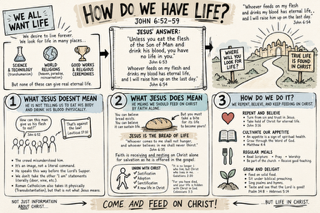
We all desire to live forever. We look for eternal life through science and technology, through religion and good works, and through various ideas about what happens after death. But how do we actually take hold of eternal life?
Jesus gives us a startling answer: “Unless you eat the flesh of the Son of Man and drink his blood, you have no life in you.” What does Jesus mean by this shocking statement? Is he talking about physically eating his body and drinking his blood? And if not, what does it mean to “feed on Christ”?
In this sermon, we consider what Jesus does not mean, what he does mean, and how we are called to feed upon Christ by faith. Eternal life is found not merely in knowing about Christ, but in being united to Christ by faith and continually drawing our life and nourishment from him.
Sermon Outline
1. What Jesus Does Not Mean
Jesus is not commanding us to physically eat his body and drink his blood. His language points to a spiritual reality rather than a literal, physical act.
2. What Jesus Does Mean
To eat and drink Christ means to receive and rest upon Christ by faith. Through faith, we are united to Christ, receiving all the benefits of salvation and finding our life in him.
“Whoever feeds on my flesh and drinks my blood has eternal life, and I will raise him up on the last day.” — John 6:54
3. How Do We Do It?
We feed upon Christ by faith.
Repent and believe in Jesus.
Cultivate an appetite for Christ.
Feed regularly on God's Word through private, family, and public worship.
Seek solid biblical teaching that strengthens and matures our faith.
Grow in our delight in Christ.
The Lord's Supper then gives us a visible sign and seal of this spiritual reality: Christ is spiritually present with his people, strengthening our faith as we receive the sacrament.
Study Questions
Understanding the Text
What does Jesus say is necessary for us to have eternal life? (John 6:53–54)
Why would Jesus' words about eating his flesh and drinking his blood have been so shocking to his original audience?
What did the crowd misunderstand about Jesus' words?
Why should we understand Jesus' language about eating and drinking spiritually rather than physically?
How does John 6:35 help us understand what Jesus means by “eating” and “drinking” him?
What does it mean to receive and rest upon Christ by faith?
Union with Christ
What does it mean for a Christian to be “united to Christ”?
How does Galatians 2:20 describe the Christian's relationship with Christ?
What does Colossians 3:3–4 mean when it says, “Christ who is your life”?
How is being united to Christ different from simply believing facts about Jesus?
Feeding on Christ
What is the difference between believing that food can nourish you and actually eating it? How does this help explain faith?
Why is spiritual appetite important in the Christian life?
What are some “holy habits” that help cultivate our appetite for Christ?
How do Scripture, prayer, worship, and the life of the church nourish our faith?
What does it mean to pursue a healthy spiritual diet?
Why do we need solid biblical teaching as we grow in Christian maturity?
Application
Are you trusting in Christ himself for eternal life, or are you trusting in something else—good works, religious activity, or simply knowing about Christianity?
What might be weakening your appetite for Christ?
What is one practical way you could feed more regularly on God's Word this week?
Are you merely going through Christian habits, or are you growing in delight in Christ?
What does it look like for you to continually “feed on Christ” throughout an ordinary week?
For Reflection
“Oh, taste and see that the LORD is good!” — Psalm 34:8
Christ is not merely someone we know about. Christ is our life. How would your life change if you increasingly lived as though that were true?