John 4:25-42 | "How to Be a Faithful Witness"


John 4:25-42 | "How to Be a Faithful Witness"
Pastor Will Stern

Sermon Description

In John 4:25–42, Jesus transforms three very different groups into faithful witnesses for the glory of God. The woman at the well encounters Jesus and immediately begins inviting others to meet Him. The disciples receive instruction from Jesus and learn to see the fields as white for harvest. The Samaritans spend time with Jesus and move from secondhand faith to personal conviction, confessing Him as "the Savior of the world." In this sermon, we discover that faithful witness does not begin with better techniques, but with a deeper relationship with Christ. Some need an encounter with Jesus. Some need instruction from Jesus. Some need more time with Jesus. How might Christ be calling you to grow as a faithful witness? 

Sermon Outline

How Can We Be Transformed into Faithful Witnesses for the Glory of God?
John 4:25–42

I. You Need an Encounter with Jesus

(John 4:25–30)

  • Jesus reveals Himself as the Messiah.

  • The woman leaves her water jar and goes into town.

  • A genuine encounter with Christ produces a desire to tell others about Him.

II. You Need Instruction from Jesus

(John 4:27, 31–38)

  • The disciples lose sight of their mission.

  • Jesus teaches them to lift up their eyes and see the harvest.

  • Faithful witnesses learn to see people through the eyes of Christ.

III. You Need Time with Jesus

(John 4:39–42)

  • The Samaritans initially believe because of the woman's testimony.

  • They spend two days with Jesus.

  • Their faith deepens into personal conviction: "This is indeed the Savior of the world."

Main Idea:
Jesus transforms ordinary people into faithful witnesses through encounters with Him, instruction from Him, and time spent with Him. 

Study Questions

  1. Why is Jesus' statement in John 4:26 so significant? What does it reveal about His identity?

  2. What does the woman's response teach us about the relationship between encountering Christ and sharing our faith?

  3. Why were the disciples surprised to find Jesus speaking with the Samaritan woman?

  4. What does Jesus mean when He says, "The fields are white for harvest"?

  5. In what ways can Christians lose sight of the mission Christ has given them?

  6. How did the Samaritans move from believing the woman's testimony to personal conviction about Jesus?

  7. What is the difference between secondhand faith and firsthand faith?

  8. How do God's Word, prayer, worship, and Christian fellowship help us spend time with Jesus?

  9. Which group do you most identify with right now: the woman, the disciples, or the Samaritans? Why?

  10. What is one specific way you can grow as a faithful witness this week?

Key Verse:

"It is no longer because of what you said that we believe, for we have heard for ourselves, and we know that this is indeed the Savior of the world." — John 4:42 (ESV) 

John 4:20-24 | "Jesus Answers Two Questions About Worship"


John 4:20-24 | "Jesus Answers Two Questions About Worship"
Pastor Will Stern

John 4:19–24

If you attended church for 50 years, you would spend thousands of hours gathered with God's people in worship. Worship is not only a central part of the Christian life—it is the very purpose for which we were created. In this sermon from John 4:19–24, Jesus answers two foundational questions about worship: Where should we worship? and How should we worship? As Jesus speaks with the Samaritan woman at the well, he reveals that true worship is no longer tied to a sacred place but is centered on a Savior. Through his life, death, and resurrection, Christ becomes the true temple, gathering worshipers from every nation who worship the Father in spirit and in truth.

Outline

  1. Where Should We Worship? (John 4:19–22)

    • Mt. Gerizim or Jerusalem?

    • Salvation is from the Jews.

    • Christ, the true Temple.

  2. How Should We Worship? (John 4:23–24)

    • Worship in Truth

    • Worship in Spirit

    • True worship: fire and wood together.

  3. Warning, Encouragement, and Challenge

    • A warning about false worship.

    • An encouragement that the Father is seeking worshipers.

    • A challenge to join God's mission of gathering worshipers.

Questions for Reflection

  • Why was the debate between Mt. Gerizim and Jerusalem so important to the Samaritan woman?

  • What does Jesus mean when he says that "salvation is from the Jews"?

  • How does Jesus fulfill and replace the Old Testament temple?

  • What does it mean to worship God "in truth"?

  • What does it mean to worship God "in spirit"?

  • Which danger are you more prone to: truth without spirit or spirit without truth?

  • How can you better prepare your heart for worship each Lord's Day?

  • In what ways can your family life and private devotional life become more centered on worship?

  • How does evangelism relate to God's purpose of gathering worshipers for himself?

  • What is one practical way you can prioritize worship this week?

Key Verse

"God is spirit, and those who worship him must worship in spirit and truth."
— John 4:24 (ESV)

John 4:16-19 | "Grace and Truth"


John 4:16-19 | "Grace and Truth"
Pastor Will Stern

Grace and Truth
John 4:16–19

In this sermon from John 4:16–19, we see Jesus as the searching Savior who is “full of grace and truth.” As Christ lovingly exposes the Samaritan woman’s deepest sins, we are reminded that Jesus does not ignore sin, nor does He crush sinners with shame. Instead, He shines the light of truth into the darkest places of our hearts in order to lead us to repentance, forgiveness, and transformation. This message explores how Christ confronts our “keystone sins” with truth while drawing sinners to Himself with remarkable grace and compassion. 

Outline

  1. Jesus Is Full of Truth

  2. Jesus Is Full of Grace

  3. Grace and Truth at the Cross

Questions for Reflection

  • What areas of your heart would Christ’s searching light expose?

  • Are you tempted to think of Jesus as all grace without truth—or all truth without grace?

  • How does the cross display both God’s holiness and His mercy?

  • In what ways can Christians show both grace and truth to others.

John 4:7-15 | “Living Water"


John 4:7-15 | “Living Water"
Pastor Will Stern

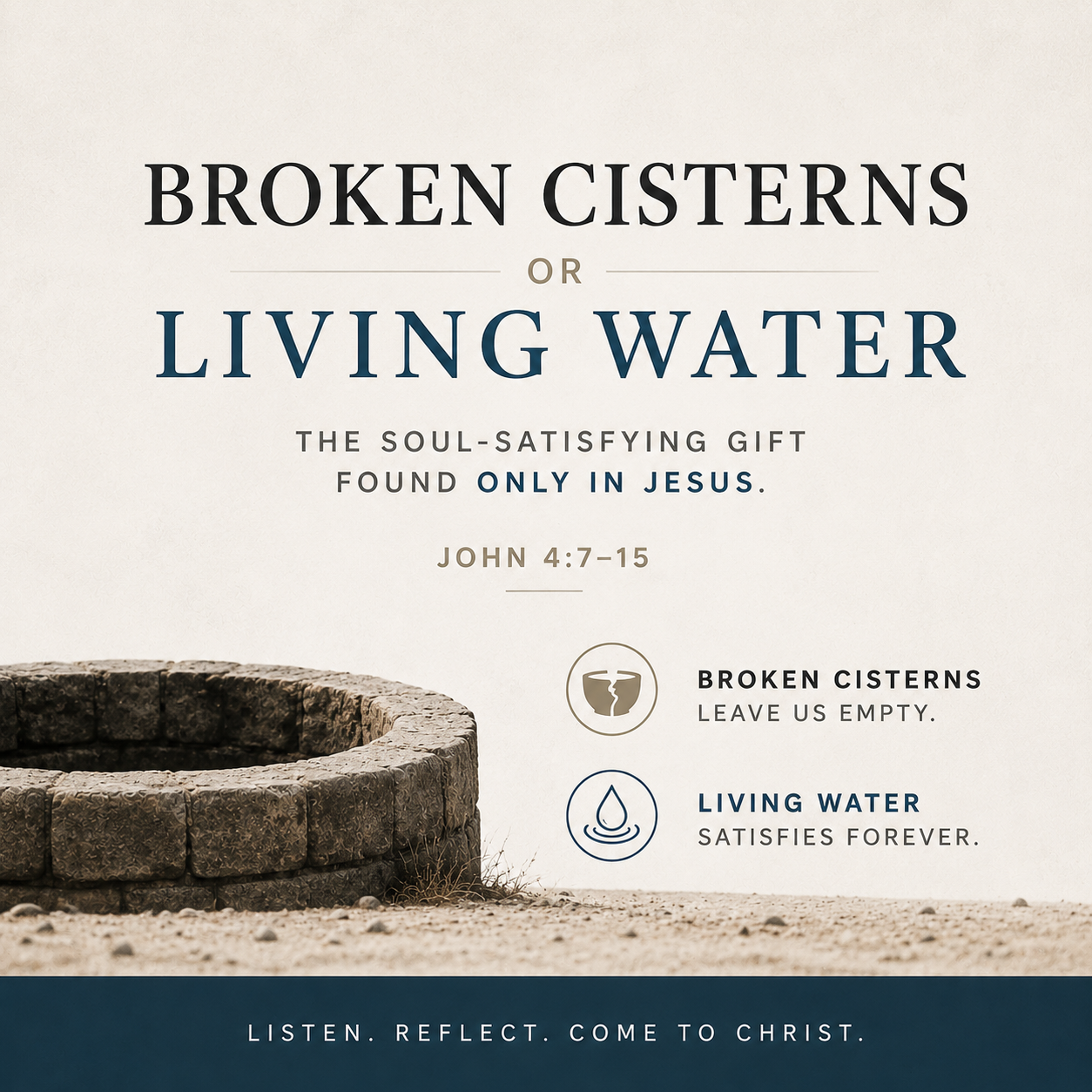
In John 4:10–14, Jesus meets a broken and cynical Samaritan woman who has spent her life searching for satisfaction in things that could never truly fill her soul. Using the imagery of “broken cisterns” from Jeremiah 2, this sermon explores how we all seek meaning, joy, and identity in places that ultimately leave us empty. But Christ offers something infinitely better: living water that wells up to eternal life. Listen as we consider the emptiness of false saviors, the free offer of the gospel, and the soul-satisfying gift of the Holy Spirit found only in Jesus Christ.

Outline

    1    Broken Cisterns

    2    Living Water

Questions for Reflection

    •    What “broken cisterns” are you tempted to look to for satisfaction instead of Christ?

    •    Why do good things like family, success, or comfort fail to satisfy our deepest thirst?

    •    What does Jesus mean when He offers “living water”?

    •    How does the Holy Spirit satisfy and transform believers?

    •    What does it look like to keep “coming to Christ” as a believer?

John 4:1-7 | “Sinner-Seeking Savior”


John 4:1-7 | “Sinner-Seeking Savior”
Pastor Will Stern

Sermon Summary:
In John 4:1–15, we meet a deeply broken Samaritan woman—but before she ever sought Jesus, Jesus was already seeking her. This sermon explores how Christ is a sinner-seeking Savior who came into the world to draw near to sinners, become weak for them, and initiate a relationship with them. Jesus “had” to pass through Samaria because it was the will of His Father to seek and save the lost. Through His weariness at the well and His conversation with this outcast woman, we see the grace of a Savior who crosses every barrier to bring living water to spiritually thirsty people.

Sermon Outline:

  1. Jesus seeks sinners by drawing near to them

  2. Jesus seeks sinners by becoming weak for them

  3. Jesus seeks sinners by initiating a relationship with them

Key Takeaway:
Jesus is not waiting for sinners to clean themselves up before coming to Him. He is the One who takes the initiative, draws near, and offers living water to all who are spiritually thirsty.

Application Questions:

  • Do you believe Jesus could truly seek and save someone as broken as you?

  • In what ways are you trying to satisfy your spiritual thirst apart from Christ?

  • How does Christ’s willingness to draw near to sinners shape the way you view other people?

  • What might it look like for you to respond to Christ’s invitation today?

Isaiah 58:13-14 | "Delighting in the Sabbath"


Isaiah 58:13-14
Pastor Will Stern

Do you want to delight in God more?

In Isaiah 58:13–14, God makes an incredible promise: that His people will delight in Him, be lifted up in their spiritual lives, and be deeply satisfied in His provision. But this promise doesn’t stand alone—it comes with a path.

In this sermon, we explore what it means to truly honor the Lord’s Day. What does it look like to stop trampling it? How can we learn to delight in it rather than endure it? And how does setting apart one day in seven actually lead us into deeper joy in God?

Far from being a burden, the Sabbath is a gift—a weekly invitation to rest, worship, and communion with God. And ultimately, it points us to Jesus Christ, the Lord of the Sabbath, in whom true rest and lasting delight are found.

Outline:

  • The Promise: Delight, elevation, and satisfaction in God (Isaiah 58:14)

  • The Problem: Trampling the Lord’s Day

  • The Invitation: Delighting in the Lord’s Day

  • The Practice: Honoring the Lord’s Day in everyday life

Main Takeaway:
If you want to delight in God, learn to delight in the day He has set apart for Himself.

Application Questions:

  1. In what ways might you be treating the Lord’s Day like any other day?

  2. Do you view Sunday more as a burden or a gift—and why?

  3. What would it look like to structure your day around worship, rest, and fellowship?

  4. How does Jesus, the Lord of the Sabbath, reshape the way you think about rest?

John 3:22-30 | “He Must Increase, I Must Decrease”


John 3:22-30 | "He Must Increase, I Must Decrease"
Pastor Will Stern

What if your lack of joy, constant comparison, or tendency to argue is actually rooted in pride? In this sermon from John 3:22–30, we examine how pride subtly shapes our hearts—and how true humility leads to freedom, joy, and a life centered on Christ.

John the Baptist’s disciples reveal three common marks of pride: being argumentative, competitive, and self-exalting. In contrast, John himself models true humility—marked by thankfulness, joy, and a desire to exalt Christ above all.

At the heart of this passage is John’s well-known confession: “He must increase, but I must decrease.” This is not only a statement about John’s ministry, but a call for every believer. As we grow in the Christian life, we learn to take our eyes off ourselves and fix them more fully on Christ—finding that our greatest joy is found in Him.

Outline:

Three Marks of Pride:

  1. Argumentative

  2. Competitive

  3. Self-exalting

Three Marks of Humility:

  1. Thankful

  2. Joyful

  3. Christ-exalting

Key Verse:
“He must increase, but I must decrease.” (John 3:30)

Questions for Reflection:

  • Where does pride show up in my relationships or conversations?

  • Do I find myself comparing or competing with others?

  • Is my joy rooted in Christ—or in how I measure up to others?

  • What would it look like today to decrease so that Christ might increase?

Isaiah 52:13-15 | Good Friday


Isaiah 52:13-15 | Good Friday
Pastor Will Stern

What if your suffering isn’t meaningless—but part of God’s plan to prepare you for glory? In this sermon from Isaiah 52:13–15, we look to the Suffering Servant—Jesus Christ—to understand how to face suffering with hope, confidence, and even purpose.

Isaiah shows us both the heights of Christ’s exaltation and the depths of His suffering, reminding us that the path to glory always runs through the cross. As those united to Christ by faith, our lives follow the same pattern: suffering now, glory to come. And even more, God uses our suffering for redemptive purposes beyond what we can see.

If you are suffering—or preparing to suffer—this passage calls you to lift your eyes to Christ, who was marred for us, exalted for us, and now leads us through both suffering and glory.

In This Sermon, You’ll Discover:

  • Why remembering the end of the story changes how you endure suffering

  • How Christ’s suffering and exaltation shape the Christian life

  • Why suffering should not surprise the believer

  • How God uses suffering for redemptive purposes

  • Where to find real hope when life is hard

Sermon Outline:

1. Remember the Prize (Exaltation with Christ)

  • Christ was exalted—and we will share in His glory

  • Future glory gives strength for present suffering

2. Remember the Path (Suffering with Christ)

  • Christ was marred and rejected

  • The Christian life follows the same path: suffering before glory

3. Remember the Purpose (Redemption through Christ)

  • Christ’s suffering accomplished salvation

  • Our suffering, in union with Him, is not wasted

Main Takeaway:
Because we are united to Christ, our suffering is not meaningless—it is part of the path to glory and is used by God for redemptive purposes.

Questions for Reflection:

  • Am I surprised by suffering, or do I see it as part of following Christ?

  • Where am I tempted to believe my suffering is meaningless?

  • How does the promise of future glory shape the way I endure hardship today?

  • In what ways might God be using my suffering for His purposes?

  • How can I fix my eyes more fully on Christ in the midst of difficulty?